How to receive the answer?
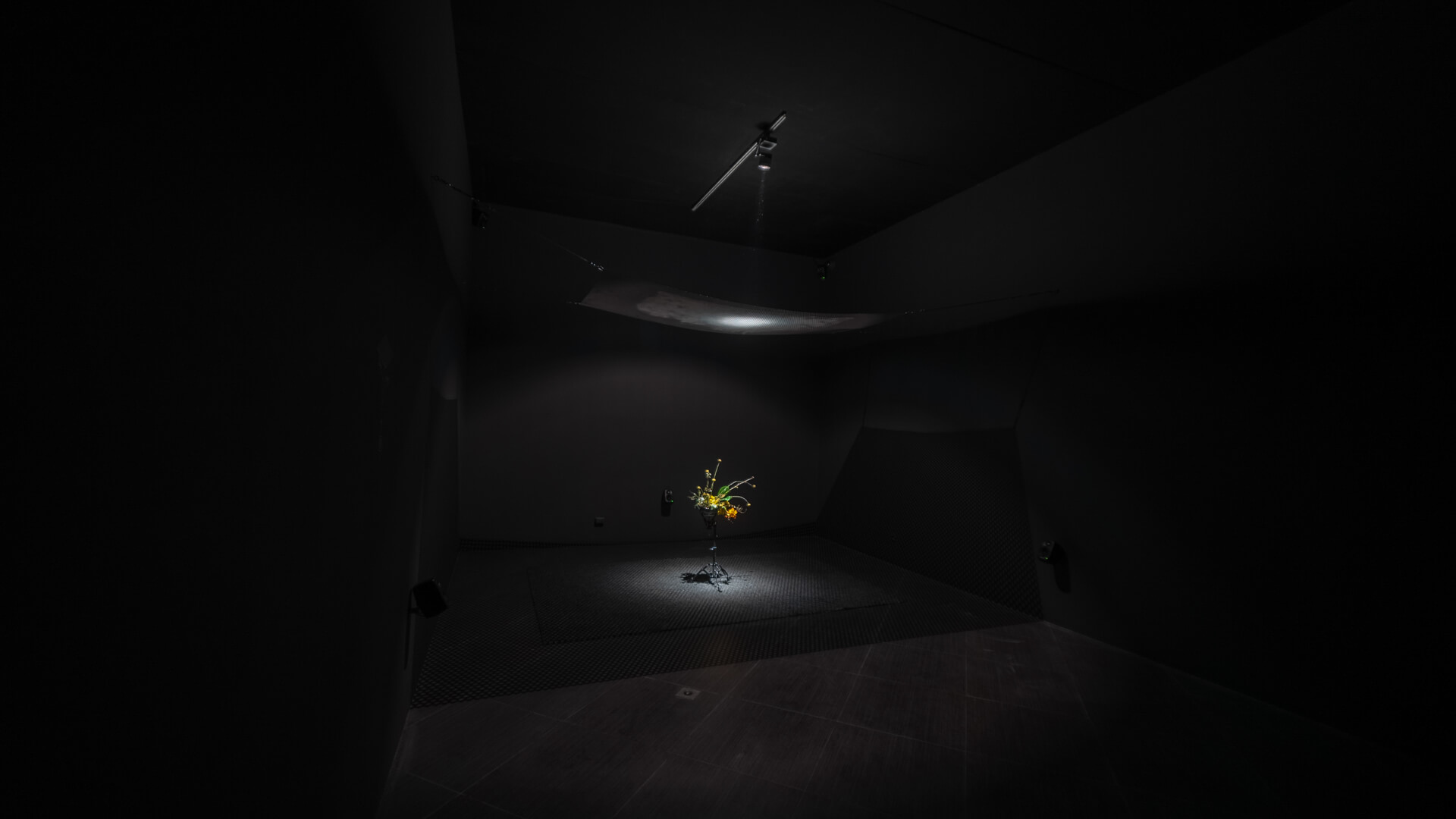
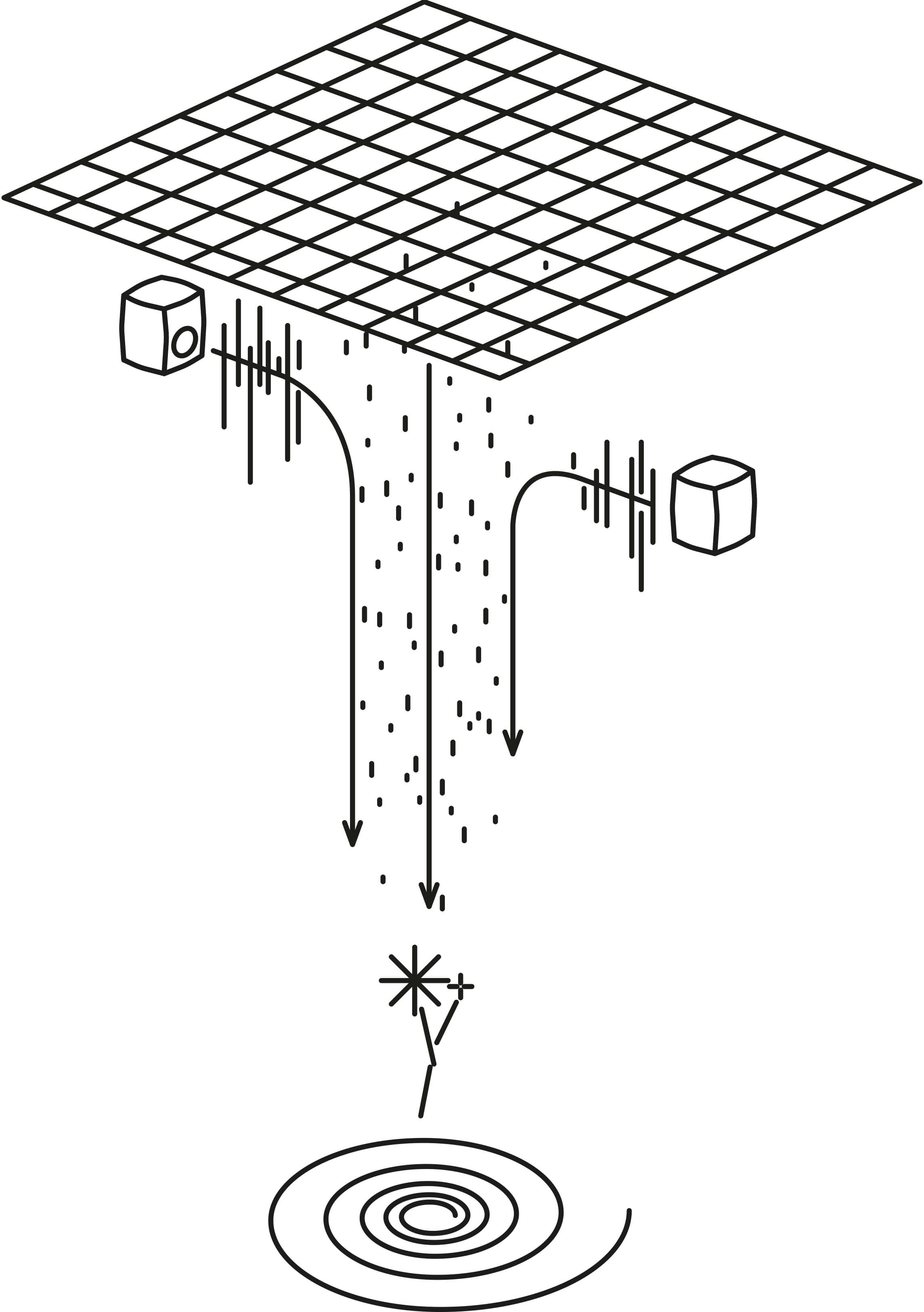
«How to Receive the Answer?» is a project about the search for connection beyond time. At its core is cosmic microwave background radiation, the primordial light of the universe captured by the Planck space mission. In dialogue with scientists from the Special Astrophysical Observatory of the Russian Academy of Sciences, Vasiliy Sumin sonified this data, isolating eight primary harmonics. Eight acoustic speakers, a floral composition, and volcanic ash created a closed model of the universe, in which sound waves from the harmonics caused particles of ash to fluctuate through space.
Fluctuating particles of volcanic ash generate local gravitational fields. According to the hypothesis of the graviton (a massless particle, the quantum of the gravitational field, not bound to time), gravity is not subject to entropy and has remained unchanged since the origin of the universe. In this capacity it becomes a hypothetical transmitter: the trace left by ash particles under the influence of the harmonics of cosmic microwave background radiation forms the syntax of a signal capable of reaching beyond time. It is a message about humanity’s knowledge of the early stages of the universe, and also a coordinate in time, since the universe is cooling and the sampling frequency of the cosmic microwave background gradually decreases as it expands; this data captures a specific moment in the history of the cosmos.
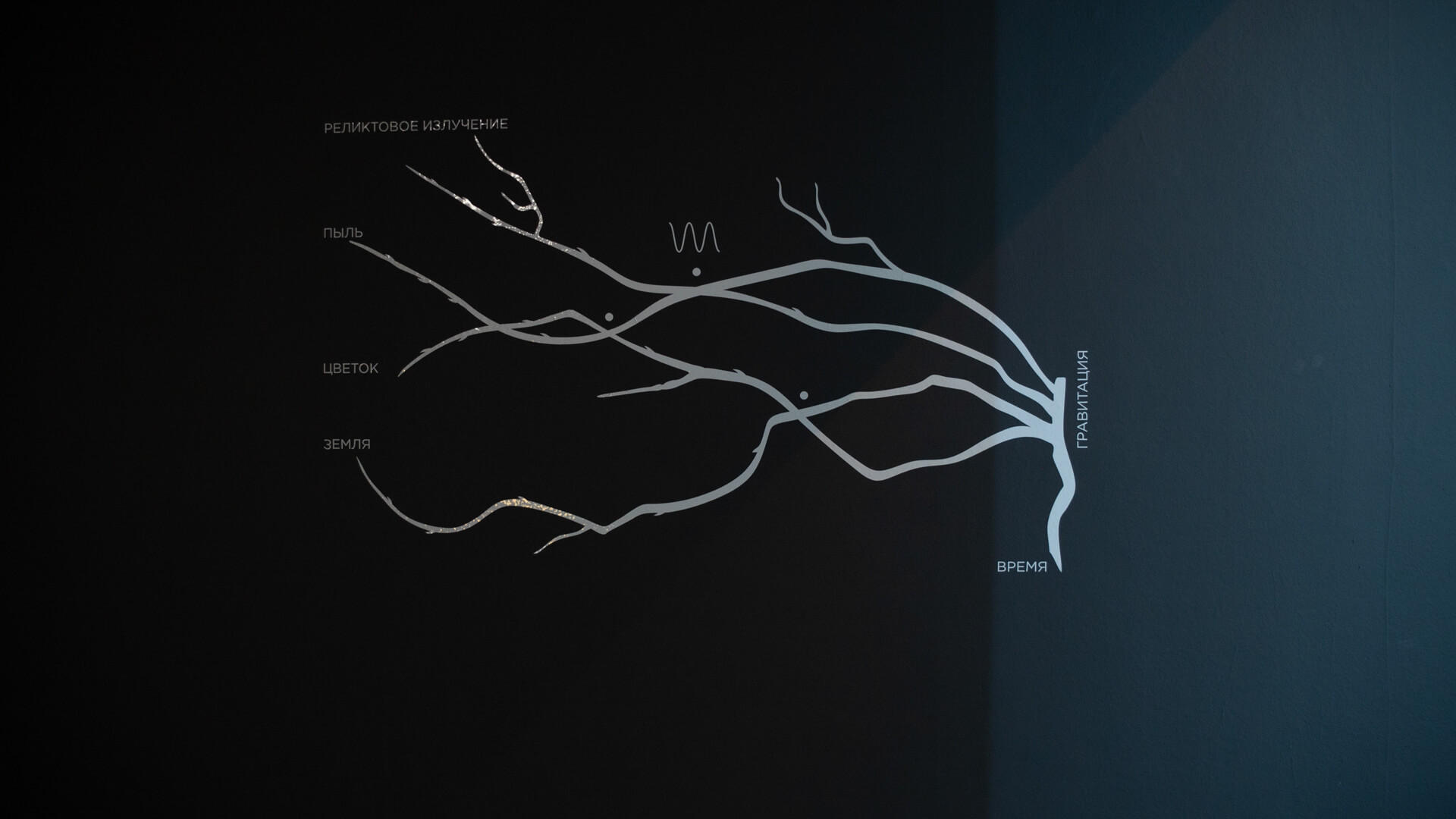
As the particles settle onto the fading floral composition, they close three layers of the project. The first is what humanity knows: cosmic microwave background radiation as evidence of the beginning of the universe. The second is what physics suggests: eleven spatial dimensions, not the four we perceive. The third is what humanity does not know how to face: entropy and fading. The project offers no answer; it asks a question: how do we receive one?
Dedicated to astrophysicist Oleg Verkhodanov, consultant, co-author, and friend, who passed away on April 5, 2020.
Architect: Jadkar Jernigovski
Illustrations: @amil_nitrrite, Vita Shakhnovich, Vika Boyko


Sonification Cosmic microwave background
In order to perform sonification of the cosmic microwave background (CMB) we used data obtained by the space observatory Plank. The main goals of the Plank satellite are: building a map of the CMB temperature anisotropy, decomposition of this map into spherical harmonics and determination of the main cosmological parameters. The temperature anisotropies are usually expressed through a spherical harmonic expansion of the CMB sky: using the alm factors:
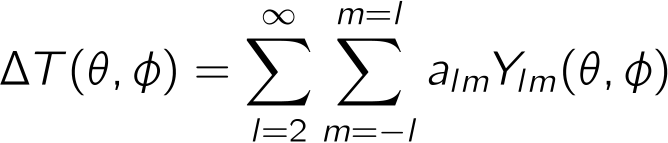
here∆T (θ, φ) are the observed temperature variations on the sky represented in spherical coordinates (θ,φ). The Ylm functions have two indices l and m. The first one l is the order number of a spherical harmonic (multipole) which corresponds to the sizes of cold and hot spots on the celestial sphere. The second one m is the mode of a multipole l. The mode reflects how these spots with the given sizes are spatially distributed on the sky. The weighted sum of all spherical harmonics gives us the map of the CMB anisotropies.
A contribution of a spherical harmonic to the map can be estimated:
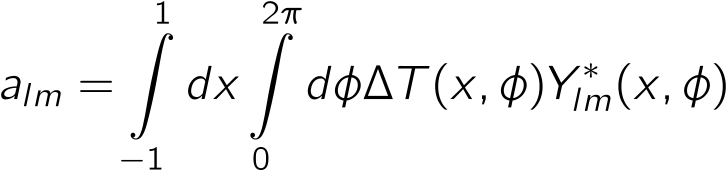
where Y*lm– denotes complex conjugation of Ylm, x = cos θ, and θ is a polar angle. Usually only the high-order harmonics (l ≥ 2) are considered in analysis of the CMB anisotropy, because they include valuable cosmological information. Specifically, the monopole l = 0 shows the average temperature of the CMB (2.7 K), and the dipole l = 1 reveals the total motion vector of Earth. One of the most important characteristic of the CMB is its angular power spectrum which is represented by a weighted sum of square amplitudes of the harmonics modes for a given index l:
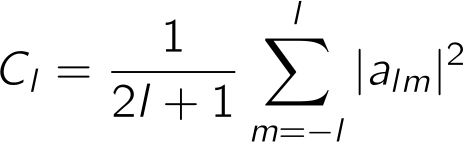
Note that here we suggested a gaussian distribution of 2l+1 coefficients alm and the averaging were carried out over an ensemble of universes. The alm factors as well as the corresponding angular power spectrum are deeply connected with mechanisms that produced the primordial density fluctuations. The physical conditions that led to the formation of these primordial fluctuations are determined by the fundamental cosmological parameters.
Those parameters are actually “imprinted” in the current (up-todate) power spectrum of the CMB, and they are basically responsible for the contemporary state of our Universe. Therefore, the power spectrum Cl is a function of the cosmological parameters:

Here h = H0/100 km s−1 Mpc−1 is the Hubble constant, Ωb is the density of baryonic matter, ΩCDM is the density of the dark matter, ΩΛ is the density of the dark energy, Ων is the density of massive neutrinos and n is the spectral slope of adiabatic fluctuations. Then, we used the angular power spectrum to generate an audible sound related to the spherical harmonics of the CMB via sinusoidal oscillators. The oscillator frequencies are determined by the relation fl = 2fl−1. Also, we mixed the sound of the CMB with a pink noise S(f ) ∝ 1/f that corresponds to the noise produced by the HEMP amplifier (High Electron Mobility Transistor), one of the crucial instruments onboard of the space observatory Plank. Then, the harmonics of the CMB were distributed over a sphere with a constant panoramic rotation and converted to the ambisonic 360∝ audio format in order to be reproduced on a spherical acoustic array.
— Alexey Medvedev, PhD in Physical and Mathematical Sciences